
About Us
SOCRATES is the Rutgers Robotics NRT (National Research Traineeship) awarded September 2020. This program will create a new vehicle for graduate training and convergence research that integrates the technology domains of robotics with social and behavioral sciences, including psychology, cognitive science and urban policy planning.

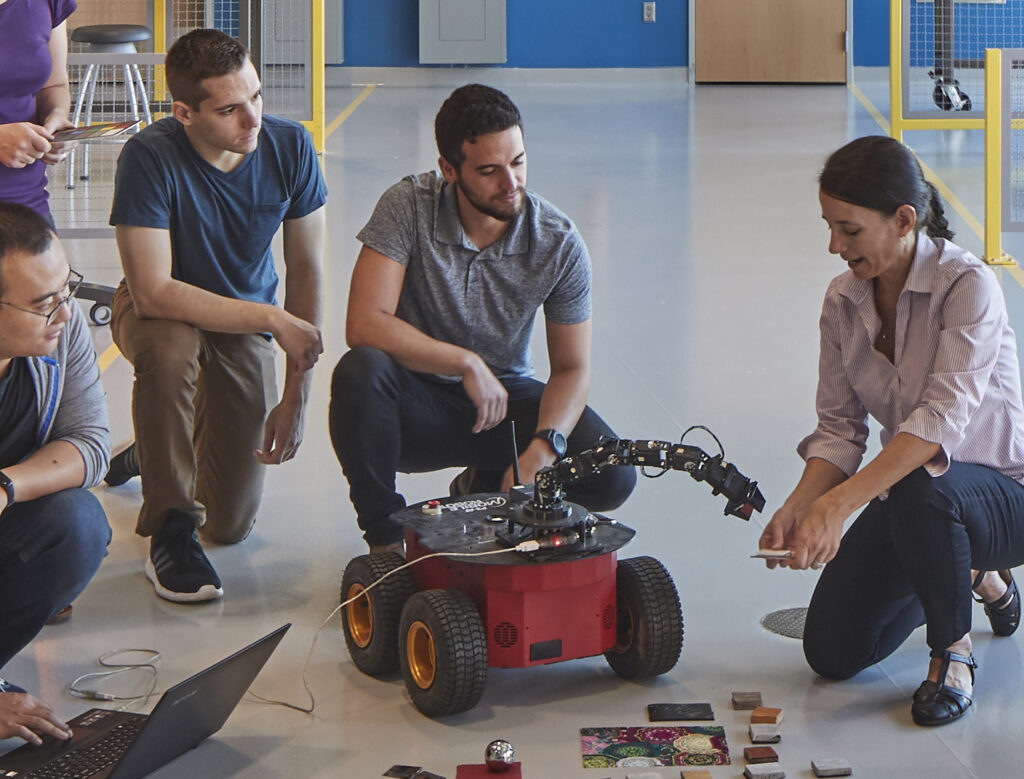
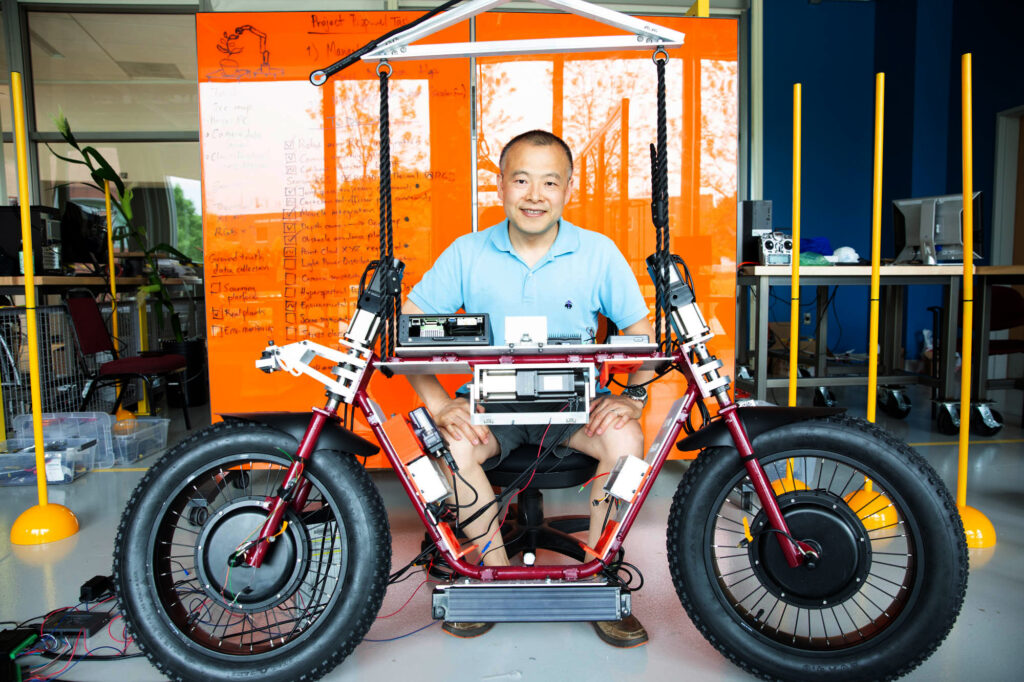
Emerging applications of robotics, from telepresence, transportation, elder-care, remote health care, cleaning, to warehouse logistics and delivery, will bring significant changes in individuals’ lives and profound social impact, especially relating to The Future of Work, an area of national priority. The limited availability of graduate training that integrates STEM and social sciences makes the nation less prepared for the impact of robotics on jobs, the associated societal consequences and how technological developments are shaping public discourse.
The traditional objective of robotics research has been to provide automated platforms that operate at high-speed, accurately and consistently, such as in the context of manufacturing systems. As robots are being deployed in a wider variety of domains, it becomes important to consider other aspects, such as safety, adaptability to human desires, and nuanced societal impacts. At the same time, traditional social sciences are studying the effects of technology on society after the deployment and wide use of the corresponding tools. Given the potential impact that robotics can have, we cannot afford to evaluate the societal and human impact of this technology aposteriori. Thus, key questions arise:
What research can catalyze positive social impact with feasible advances in the state-of-the-art? How can costly mistakes be avoided in robotics technology development and adaptation? Current training does not equip researchers (in technology, social science or policy) with the interdisciplinary tools, theories and perspectives necessary to answer such questions. The vision of SOCRATES is to fill this gap.
The SOCRATES program has a signature emphasis on the REAL challenge (Robotics for Everyday Living), so that research and class projects will focus on application domains in everyday life and work. The program aims to train a new type of professional, the socially cognizant roboticist, which will arise from the convergence of:
- Socially aware technologists, who must be able to develop intelligent devices in ways that coordinate with existing human and social behavior; and
- Technology-aware social scientists and policy-makers who can translate studies of robotics’ social effects into actionable and technically-viable lessons
Rutgers Robotics Workshop
September 22, 2023
9:00am – 4:00pm
Civic Square Building, New Brunswick, NJ
(Industry Consortium Meeting by invite, 4:00-5:00pm)
The workshop is held annually as part of the NSF National Research Traineeship SOCRATES (Socially Cognizant Robotics for a Technology Enhanced Society) at Rutgers. This annual robotics workshop is held for faculty, students, and industry representatives. The workshop will have both internal and external speakers as well as a poster session for students to present their robotics research. The workshop panels will discuss robots in the age of ChatGPT as well as new robot technologies and the social impact. Please join us in person on September 22, 2023, at the Civic Square Building (33 Livingston Ave, New Brunswick, NJ) Registration is required. The workshop is free. Please register via the following form below.
Registration is required:
Click Here for Registration Form
Robotics Workshop Agenda:
8:30 – 9:00 Check – in
9:00 – 9:30 Introduction Welcoming Remarks: Prabhas V. Moghe, Executive Vice President for Academic Affairs, Rutgers University
9:30 – 10:30 Plenary Speaker, Ronald Arkin, Georgia Tech Civilized Collaboration: Ethical architectures for enforcing legal requirements and mediating social norms in Human-robot Interaction
10:30 – 10:45 Poster Spotlight Talks
10:45 – 11:30 Coffee break & Poster Session
11:30 – 12:30 Panel: Robots in the age of ChatGPT
12:30 – 1:30 Networking Lunch
1:30 – 2:30 Panel: New Robot Technologies and the Social Impact
2:30 – 3:15 Student Talks (NRT fellows/trainees)
3:15 – 4:00 Optional: Walk over to the CS Robotics Lab on 1 Spring Street, New Brunswick for demo
4:00 – 5:00 Industry Consortium meeting at 1 Spring Street (by invitation for consortium members)
Civilized Collaboration:
Ethical architectures for enforcing legal requirements and mediating social norms in Human-robot Interaction
Ronald C. Arkin
Regents’ Professor Emeritus College of Computing
Georgia Institute of Technology

Talk Abstract: The ways in which we treat each other, typically underpinned by an ethical theory, serve as a foundation for civilized activity. Bounds and requirements are established for normal and acceptable interactions between humans. If we are to create robotic systems to reside among us, they must also adhere to a set of related values that humans operate under. This talk first describes the importance of such conventions in human-robot interaction, then outlines a way forward including the difficult research questions remaining to be confronted in ethical human robot interaction (HRI). In particular, examples involving architectures using ethical governors, moral emotions, responsibility advisors and theories of mind are described in two quite different contexts: warfare and the maintenance of human dignity in healthcare. Even the role of deception must be considered as an important adjunct to HRI, as it may yield more effective intentional and autonomous social robots if properly deployed. Finally, we can consider how robots may eventually be able to engineer more socially just human beings via nudging and the ethical questions associated with using such devices.
Speaker Bio: Ronald C. Arkin is Regents’ Professor Emeritus in the College of Computing at Georgia Tech, where he also served as Associate Dean for Research. He served as STINT visiting Professor at KTH in Stockholm, Sabbatical Chair at the Sony IDL in Tokyo, member of the Robotics and AI Group at LAAS/CNRS in Toulouse, and in Brisbane Australia at Queensland University of Technology and CSIRO. Dr. Arkin’s research interests include behavior-based control and action-oriented perception for mobile robots and UAVs, deliberative/reactive architectures, robot survivability, multiagent robotics, biorobotics, human-robot interaction, machine deception, robot ethics, and learning in autonomous systems. His books include Behavior-Based Robotics, Robot Colonies, and Governing Lethal Behavior in Autonomous Robots. He has provided expert testimony to the United Nations, the International Committee of the Red Cross, the Pentagon and others on Autonomous Systems Technology. Prof. Arkin served on the Board of Governors of the IEEE Society on Social Implications of Technology, the IEEE Robotics and Automation Society (RAS) AdCom and is a founding co-chair of IEEE RAS Technical Committee on Robot Ethics. He served as a Distinguished Lecturer for the IEEE Society on Social Implications of Technology, is currently a Distinguished Visitor for the IEEE Computer Society and and a Life Fellow of the IEEE.
Click here to view the 2022 agenda
Click here to view the 2021 agenda